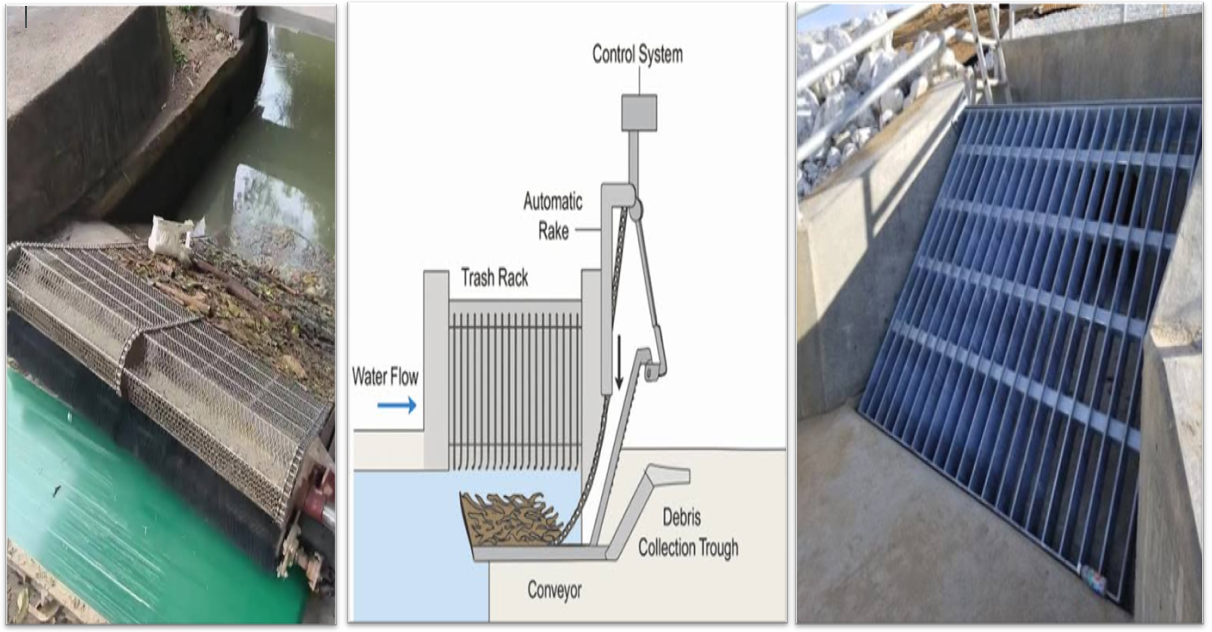
Trash Rack Cleaning Machine is an important electro-mechanical equipment installed at the intake structure of a hydropower plant. The main purpose of this equipment is to remove accumulated floating and submerged debris, such as wood logs, leaves, branches, plastic, stones and other foreign material, from the trash racks. Proper and timely cleaning of trash racks is necessary to maintain smooth flow of water towards the intake and to avoid excessive head loss and reduction in power generation.
a. Purpose of Trash Rack Cleaning Machine
The primary purpose of a Trash Rack Cleaning Machine is to keep the trash rack clean and ensure uninterrupted flow of water towards the water conductor system, turbine or pump. During operation of a hydropower plant, considerable quantity of floating and submerged debris may accumulate at the upstream side of the trash rack. If the accumulated debris is not removed in time, it can cause blockage of the openings and increase the differential water level across the trash rack.
The increase in differential head results in additional head loss and may adversely affect the efficiency and available discharge to the turbines. In severe cases, excessive loading on the trash rack may also cause structural damage or deformation of the trash rack panels. The Trash Rack Cleaning Machine therefore provides a mechanized arrangement for regular cleaning of the trash rack without requiring manual intervention. It is particularly important for hydropower plants located on rivers where the quantity of floating debris is comparatively high, especially during flood season.
The main purposes can be summarized as follows:
- To remove floating and submerged debris from the trash rack.
- To maintain adequate water flow towards the intake.
- To minimize head loss across the trash rack.
- To maintain efficient and reliable operation of the hydropower plant.
- To reduce the possibility of damage to trash rack panels due to excessive debris loading.
- To minimize manual cleaning requirements and improve safety of operating personnel.
- To ensure reliable operation during high-flow and flood conditions.
b. Types and their Advantages
Trash Rack Cleaning Machines are available in different designs depending upon the arrangement of the intake, depth of trash rack, quantity and type of debris, operating conditions and available space. The commonly used types include:
1. Rake type Trash Rack Cleaning Machine
This type consists of a mechanical rake which moves along the trash rack and collects the accumulated debris. The rake is generally operated through hydraulic cylinders, wire ropes, chains or electrically driven mechanisms.
Advantages:
- Simple and reliable arrangement.
- Suitable for large intake structures.
- Capable of removing comparatively heavy debris.
- Can be operated manually or automatically.
- Suitable for repeated cleaning cycles.
2. Travelling Type Trash Rack Cleaning Machine:
In this arrangement, the complete cleaning mechanism travels along the length of the trash rack. The machine normally consists of a supporting structure, wheels, electric drive, lifting mechanism and cleaning rake.
Advantages:
- Can cover a large trash rack area.
- Suitable for multiple intake openings.
- Provides better utilization of one machine for several trash rack panels.
- Cleaning operation can be carried out from a safe operating platform.
- Suitable for automatic or semi-automatic operation.
3. Hydraulic Trash Rack Cleaning Machine
Hydraulic cylinders are used for movement and operation of the rake. The hydraulic system provides the required force for lifting and removing heavy debris.
Advantages:
- High lifting and cleaning force.
- Suitable for heavy debris and deep trash racks.
- Smooth movement and good control.
- Compact arrangement compared with some mechanical systems.
- Suitable for heavy-duty operation.
4. Cable/Wire Rope Operated Type
In this type, the rake is operated through wire ropes connected with a winch or hoisting mechanism. The rake is lowered against the trash rack, engaged with debris and then lifted to remove the collected material.
Advantages:
- Simple operating arrangement.
- Suitable for deep water intakes.
- Relatively easy to maintain.
- Can handle heavy debris depending upon machine capacity.
- Suitable where a conventional traveling machine arrangement is difficult to install.
The selection of the appropriate type of Trash Rack Cleaning Machine depends upon the trash rack dimensions, water depth, expected quantity and type of debris, required cleaning frequency, lifting capacity and overall intake arrangement.
c. Working Principle
The working principle of a Trash Rack Cleaning Machine is based on mechanically collecting the debris accumulated on the upstream face of the trash rack and lifting it to the disposal level. During normal operation of the hydropower plant, water passes through the openings of the trash rack while debris is retained on its upstream side. As debris accumulates, the water flow through the trash rack openings is restricted and the differential water level across the trash rack increases.
When cleaning is required, the Trash Rack Cleaning Machine is positioned at the required trash rack panel. The cleaning rake is lowered towards the bottom or required level of the trash rack. The rake teeth enter between the trash rack bars and engage with the accumulated debris.
After engagement, the rake is moved upward along the inclined or vertical face of the trash rack. During this movement, the debris is collected by the rake and lifted towards the top of the intake structure. At the upper position, the rake is operated or tilted in such a manner that the collected debris is discharged into a suitable disposal arrangement, such as a debris collection platform, conveyor, truck or other disposal system. After discharging the debris, the rake returns to its initial position and the cleaning cycle is repeated as required.
In modern hydropower plants, the Trash Rack Cleaning Machine may be integrated with the plant control system. Differential level sensors, limit switches and other instruments can be provided to initiate the cleaning operation automatically when the differential water level across the trash rack reaches a preset value.
The basic sequence of operation is generally:
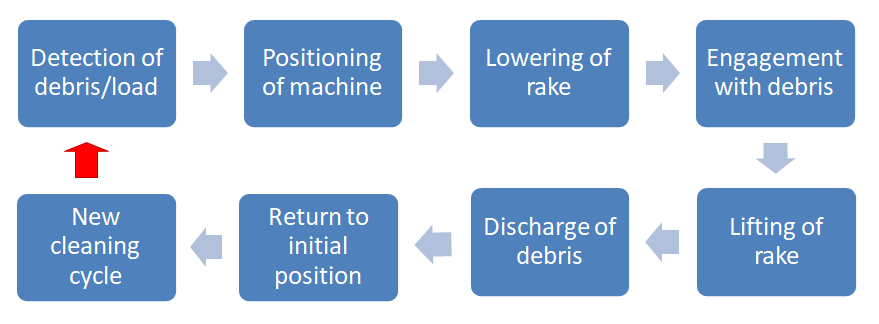
The machine may be operated through Local/Manual, Remote or Automatic mode, depending upon the design and control philosophy of the hydropower plant.
d. Maintenance and Overhauling
Regular maintenance of the Trash Rack Cleaning Machine is essential for reliable operation, particularly because failure of the machine during flood season may result in excessive debris accumulation and affect the operation of the hydropower plant. The maintenance activities should be carried out according to the manufacturer's operation and maintenance manual and the operating experience of the plant.
Routine/Preventive Maintenance
The following activities should normally be included in routine maintenance:
- Visual inspection of the complete machine and supporting structure.
- Checking of rake teeth for bending, cracking, excessive wear or damage.
- Inspection and lubrication of bearings, gears, chains, wire ropes and other moving parts.
- Checking of wire ropes for broken strands, corrosion and abnormal wear.
- Inspection of hydraulic cylinders, hoses, valves and hydraulic oil level where hydraulic operation is provided.
- Checking of electric motors, brakes, gearboxes and couplings.
- Checking of limit switches, proximity switches and position sensors.
- Inspection of electrical panels, cables, control circuits and protection devices.
- Checking of emergency stop and safety interlocking arrangements.
- Checking of bolts, nuts, welds and structural members.
- Removal of accumulated debris from the machine and operating area.
- Checking of hoisting and travelling mechanisms for abnormal noise or vibration.
Periodic Maintenance
Periodic maintenance should be carried out at suitable intervals based on the manufacturer's recommendations and operating hours. During periodic maintenance, the complete mechanical, hydraulic and electrical systems should be inspected in detail. Gearboxes should be checked for oil condition, leakage, abnormal noise and gear wear. Bearings should be inspected for temperature, vibration and excessive clearance. Wire ropes, chains and sprockets should be checked for wear and replaced where required. Electrical motors should be inspected for insulation resistance, terminal tightness, bearing condition and abnormal heating. The control panel should also be checked for proper functioning of contactors, relays, breakers, PLC/control system, indication lamps and other control components.
The hydraulic system, where provided, should be checked for oil contamination, pressure, leakage, cylinder condition and proper operation of hydraulic valves.
Overhauling
Major overhauling of the Trash Rack Cleaning Machine should be carried out at planned intervals or whenever abnormal operation, excessive wear or repeated failures are observed.
During major overhaul, the machine should be safely isolated and all necessary safety precautions should be followed. The rake assembly should be inspected and damaged or excessively worn rake teeth should be replaced. Bearings, bushes, pins, shafts, chains, sprockets, wire ropes and other critical mechanical components should be inspected and replaced or repaired as required. The gearbox should be opened and internally inspected for gear teeth wear, bearing condition, shaft alignment and lubrication system. Electric motors and brakes should be inspected and tested. Hydraulic cylinders and valves should be dismantled and checked where applicable.
The complete supporting structure should also be inspected for corrosion, cracks, deformation and damage. Welding repairs and protective coating should be carried out where necessary. After completion of overhaul, the machine should be properly assembled, aligned and tested under no-load and load conditions. Limit switches, interlocks, emergency stop arrangements and automatic control functions should also be tested before returning the machine to service.
Conclusion
Trash Rack Cleaning Machine is an important electro-mechanical equipment for reliable operation of a hydropower intake. Its proper operation ensures that the trash rack remains free from excessive debris and maintains the required water flow with minimum head loss. Selection of the suitable type of cleaning machine depends upon the intake configuration, trash rack dimensions, water depth and expected debris conditions.
Regular preventive maintenance, timely inspection and planned overhauling of the machine are essential to ensure its availability, reliability and long service life. Special attention should be given to the machine before and during the flood season, when the quantity of floating debris normally increases considerably. Proper maintenance and timely cleaning ultimately contribute towards safe, reliable and efficient operation of the hydropower plant.
Comments